 Rivendell Springs
Rivendell Springs
Rivendell Springs
Rain that fell years ago, pushed back into daylight through a thousand feet of limestone — and held at 72 degrees every day of the year.
Over a thousand of them, more than any other state — and the greatest concentration of them sits along this stretch of the Santa Fe.
A spring isn’t a source. It’s a return. Rain soaks into the ground, travels for years through the Floridan Aquifer — a hundred thousand square miles of limestone riddled with caves and conduits, holding over a trillion gallons — and is eventually forced back up through an opening in the rock. The limestone filters it on the way. That’s why the water is so startlingly clear, and why it arrives at the same temperature whatever the season: about 72°F, which feels bracing in August and almost warm in January.
Springs are measured by magnitude. A first-magnitude spring discharges more than 65 million gallons a day. Florida has around thirty of them. Two are inside a ten-minute drive of this house.
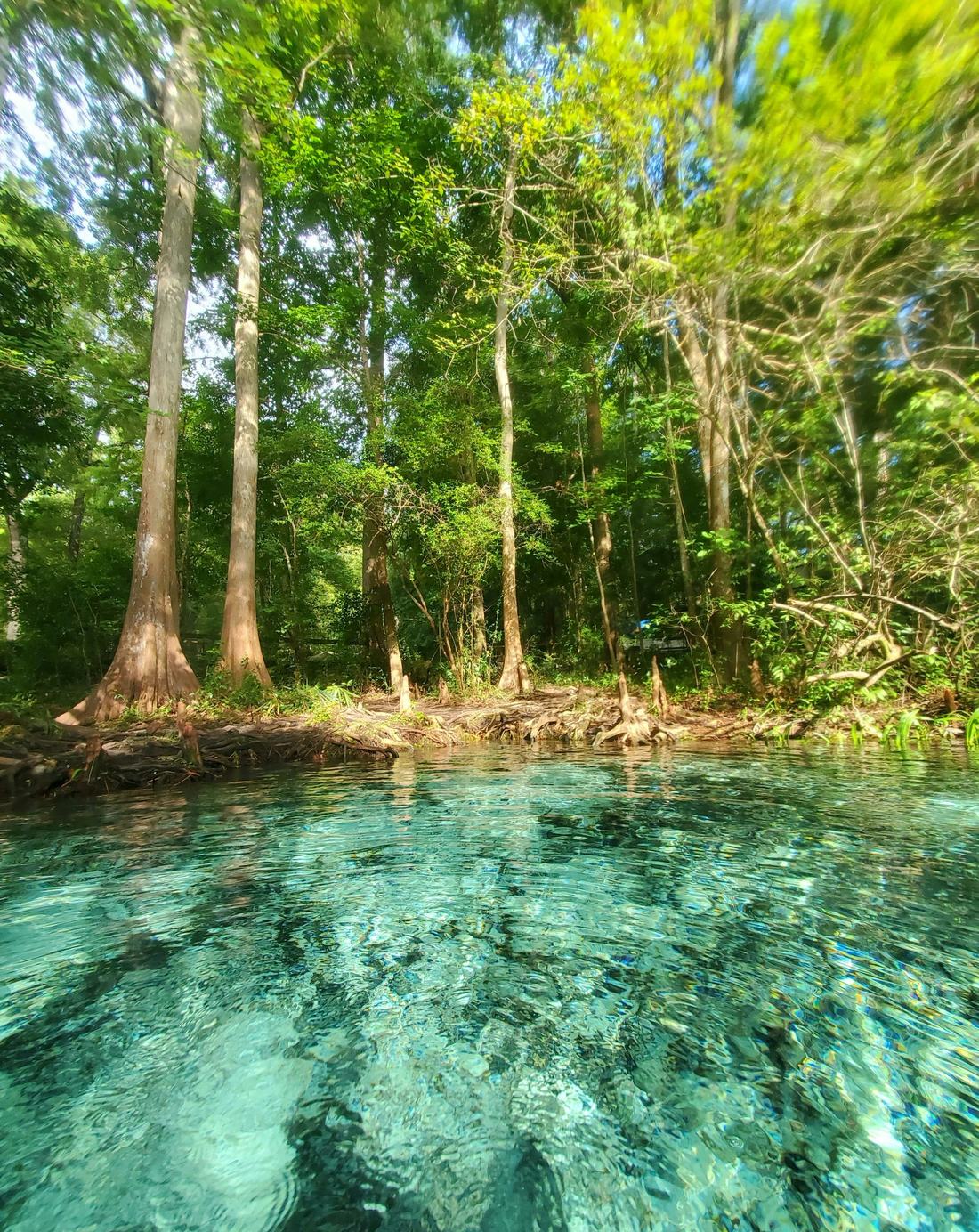
Florida holds one of the largest concentrations of freshwater springs, sinkholes and underwater caves anywhere on Earth — over a thousand springs, more than any other state — and North Florida has the densest gathering of known underwater cave systems in all of it. You are staying in the middle of that.
The reason is thirty million years old. This was seabed once, and the shells of countless marine creatures settled and compressed into limestone. Limestone dissolves in slightly acidic water, and rain made acidic by the soil has been working at it ever since — widening cracks into fissures, fissures into conduits, conduits into caverns big enough to swim through. The result is a second landscape beneath the first: a drowned network of passages carrying groundwater for miles, surfacing wherever the rock gives way.
The Santa Fe River does something extraordinary. It vanishes into the ground at O'Leno and returns three miles later. That same stone is why the water at Ginnie is clear enough to read by — it has been filtered through a thousand feet of limestone. And it is why the Devil’s cave system, ten minutes from this house, draws divers from every continent: much of modern cave-diving technique was developed in these passages, and hundreds of mapped miles later, a great deal of the network has still never been seen by anyone.
Most of the world’s karst regions have some of this. Very few have all of it in one place, at this density, with public access — and almost none of it anywhere else stays at a swimmable 72 degrees through every month of the year.
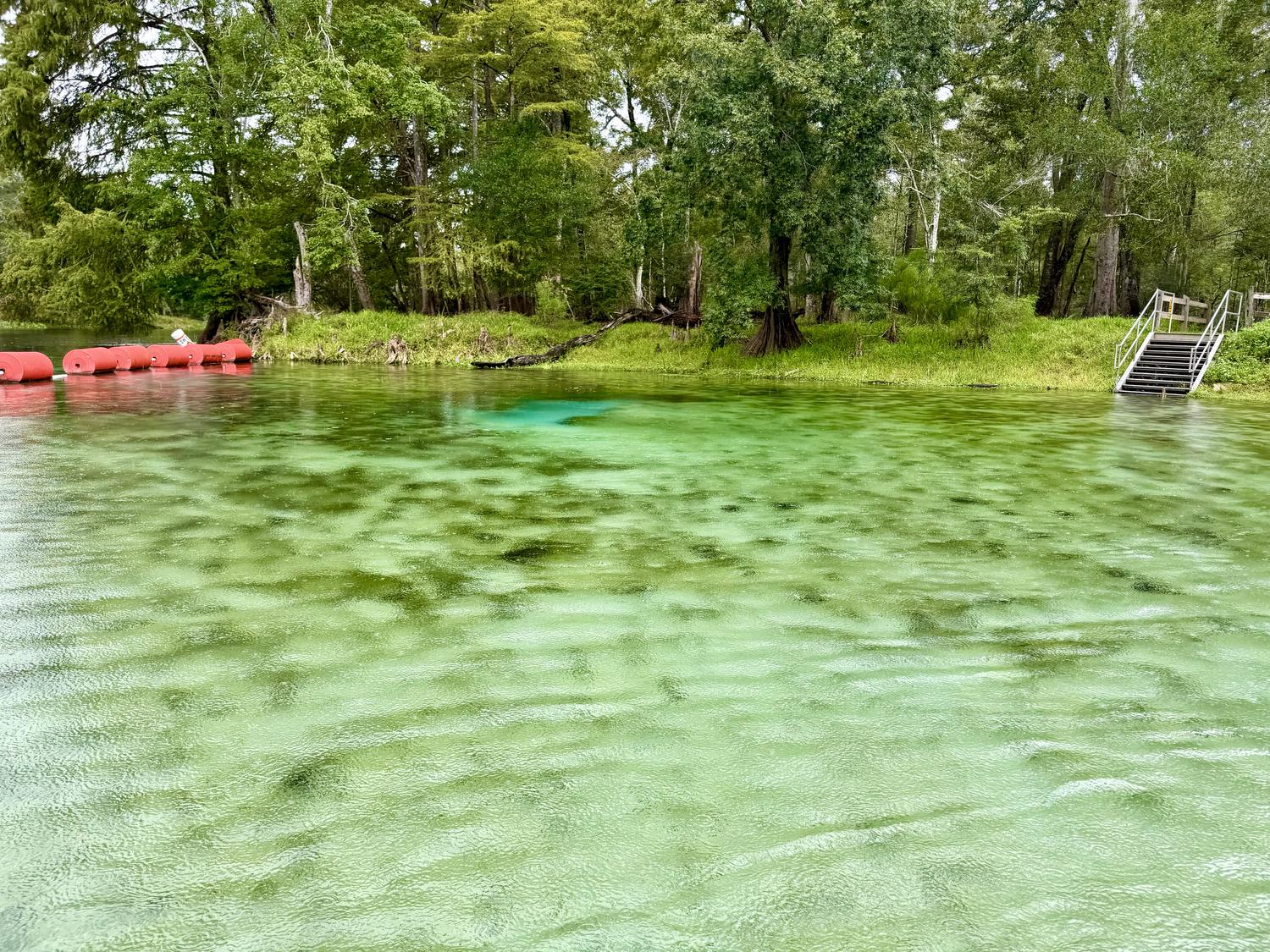
The nearest blue spring to the house, and the one we send people to first. Six separate springs feed it — Gilchrist Blue, Little Blue, Naked, Kiefer and Johnson among them — and together they push about 44 million gallons a day down the run and into the Santa Fe.
It was a private park for decades. The state bought it for $5.2 million and opened it as Florida’s 175th state park on 1 November 2017. In 2019 it was renamed for Ruth B. Kirby, who was given the property in 1958 as an engagement present from her employer, Ed C. Wright. They never married; she became executor of his estate after his death in 1969, and she and her family ran and protected the springs for the rest of her life. The park carries her name because she kept it from being developed.
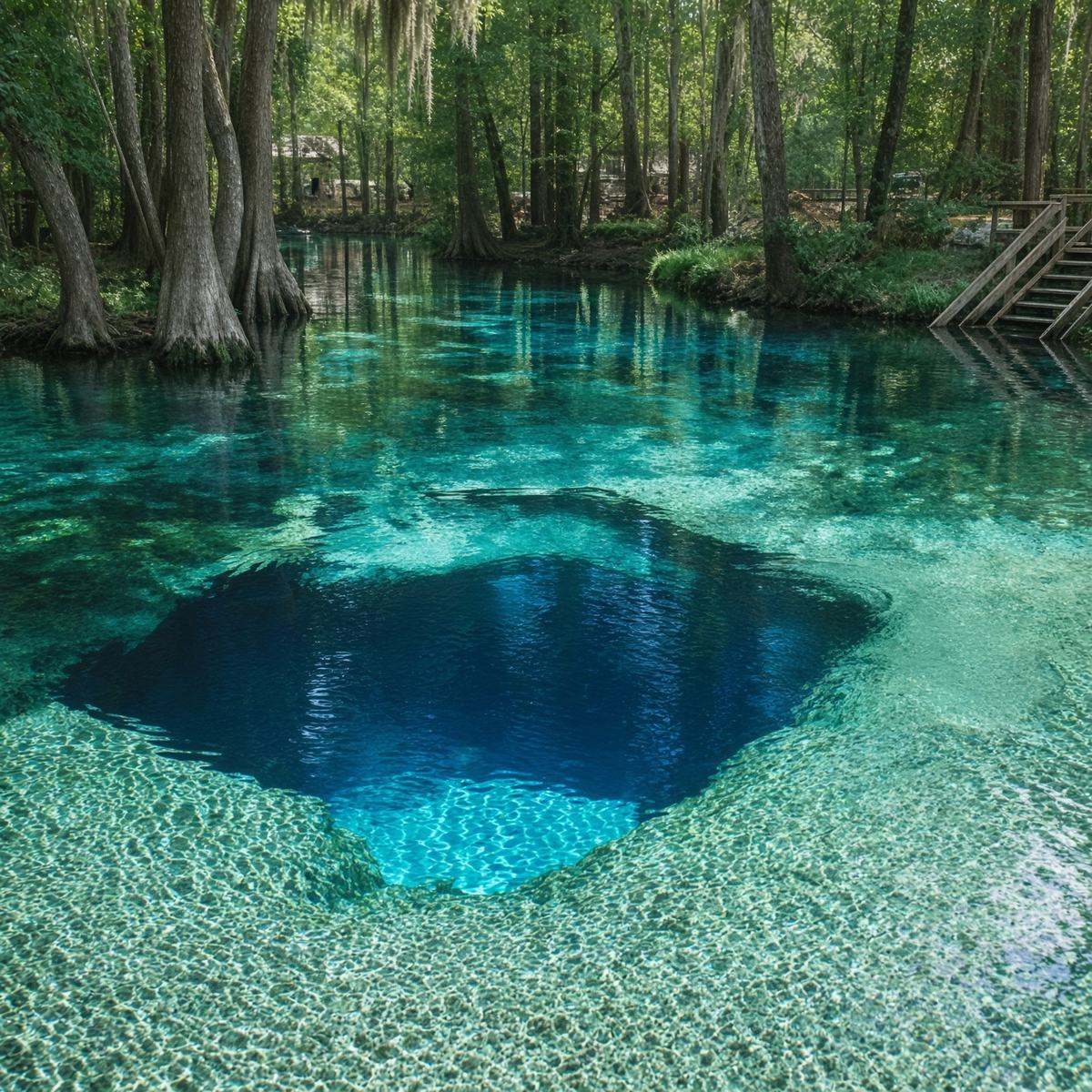
The famous one. Ginnie itself is a clear basin you can snorkel in an afternoon, but the serious water is next door: Devil’s Eye, Devil’s Ear and Little Devil, three vents over one of the best-known underwater cave systems in the world. Divers come here from every continent.
Devil’s Ear is the largest, flowing at first magnitude through a fissure in the spring run. It’s the one that pushes a visible blue plume into the tea-dark river — you can float over the boundary and watch the two waters refuse to mix. It is designated an Outstanding Florida Spring, and it is also, currently, one of the two dozen such springs the state classifies as impaired for water quality.
A Columbia County park on the north bank of the Santa Fe at Fort White, with a boat ramp, a swimming area and shaded picnic ground. Clear spring water runs out of the bank here and meets the tea-dark river, and the contrast is sharp enough to swim across. It’s also where we send guests to begin the two-hour paddle home — put in at Rum Island and the river carries you past seven springs to our bank.
A big, gentle spring in a 202-acre county park three miles west of High Springs — the only county-run park in Alachua that allows swimming. The spring sits a third of a mile from the main park area, so there’s a short walk in. Snorkelling is popular; diving isn’t permitted.
As of late 2026, Poe Springs had stopped flowing after a prolonged regional drought and the park was reported closed. This is exactly the kind of thing described further down this page. Check with Alachua County Parks before making the drive.
A spring-fed river rather than a single basin, and the most famous tubing run in Florida — a long, slow drift beneath a canopy of cypress in water clear enough to count the grains of sand. The park caps the upper river at 750 tubers a day, and in summer that limit is often reached within an hour of opening. Go early, or go on a weekday.
It’s also the one spring run we don’t share a river with — the Ichetucknee joins the Santa Fe downstream of us, so this is a drive rather than a paddle.
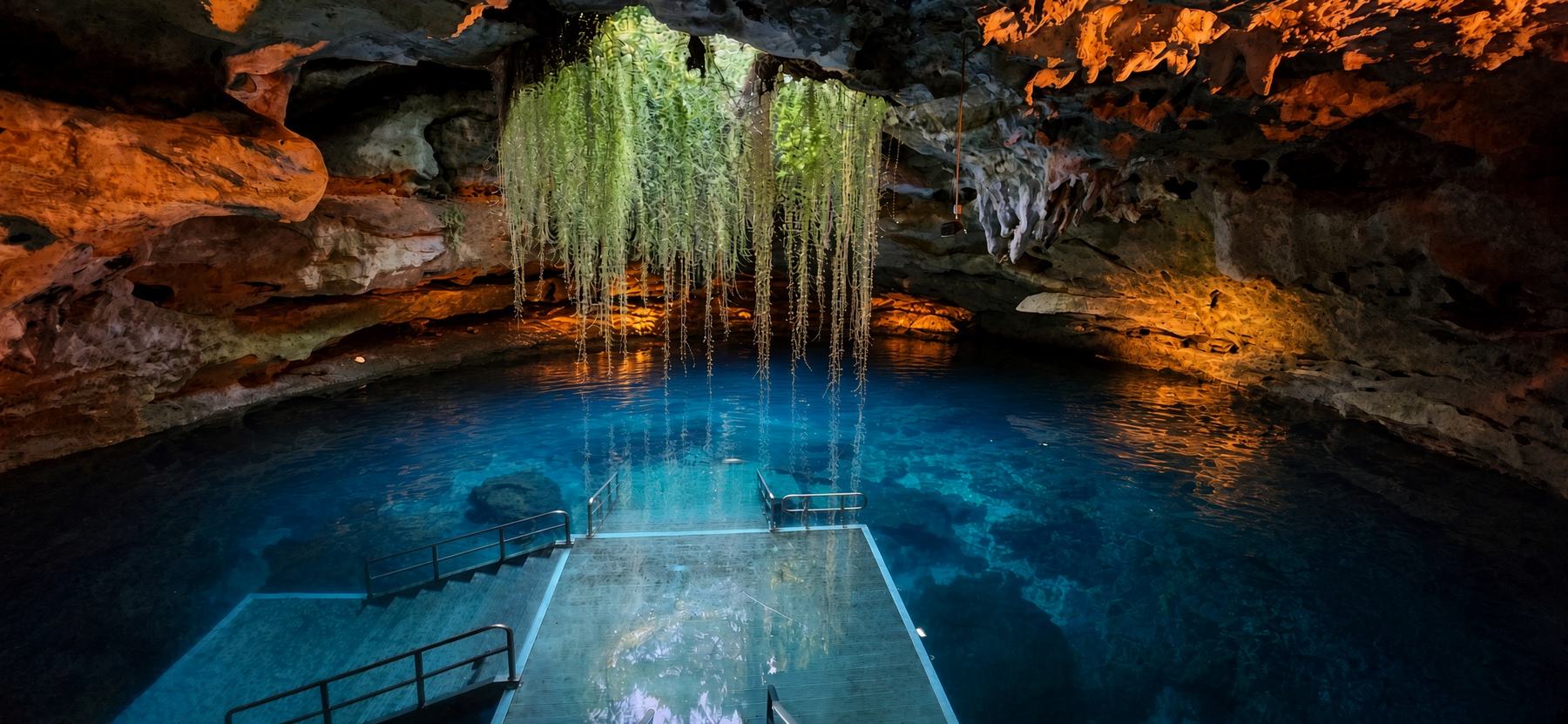
The strangest swim in Florida, and worth the drive. You walk down a flight of stairs into a cave about 120 feet across and come out beside an underground spring. The roof is closed except for a karst window — a collapsed sinkhole — and on a clear morning a single shaft of daylight falls through it onto the water. Roots hang down through the gap, and the walls hold fossil beds roughly 33 million years old.
Divers have pulled mastodon, ground sloth, sabre-toothed cat and dire wolf bones out of the passages here, along with human artefacts from the Pleistocene; most of it went to the University of Florida. Four underwater passages run from 5 to 54 feet.
One thing worth clearing up: Devil’s Den is not the same place as Devil’s Ear and Devil’s Eye at Ginnie Springs, ten minutes from us. Different springs, different counties, easily confused. Fees and policies change, so check devilsden.com before you set out.
Rented locally, per boat, per day
Single kayak from $49 · double from $69 · canoe from $65 · paddleboard from $55 — plus a park fee of around $3 a head. A family of four on the water for two days is comfortably $200–$300 before anyone buys lunch.
Staying at Rivendell Springs
Kayaks, tubes and a life jacket for every guest are here and included — and they’re a few steps from your own stretch of river, so there’s no outfitter to book, no shuttle to catch and no clock to watch.
Rental prices are what local outfitters were charging when we last checked, and are given only for comparison. We’re not affiliated with any of them.
The springs are extraordinary, they are irreplaceable, and they are under real pressure right now.
A spring is not a pond with a bottom. It is the visible end of a pressurised system. Rainwater takes years, sometimes decades, to work its way down through the limestone and across the aquifer, and it is that accumulated pressure — nothing else — that pushes water back up through the rock and out into the river. Take out more than goes in, and the pressure falls. When the pressure falls far enough, the spring simply stops.
About 2.3 billion gallons a day are pumped out of the Floridan Aquifer. It supplies roughly 90% of Florida’s drinking water, and the demand on it has never been higher: more than a thousand people move to Florida every day, each of them needing water, and each new house, road and car park also seals over ground that rain used to soak through. Less goes in. More comes out. Meanwhile the rainfall that recharges the system is becoming less reliable, and North Florida has spent much of the past two years in drought.
This is not a distant risk. Poe Springs — fifteen minutes from this house, 45 million gallons a day for most of the last century — stopped flowing this year. Flows across the Santa Fe basin are well below their historic levels. A spring that has run continuously since before there were people here can be switched off within a generation, and once an aquifer is drawn down it does not refill on any timescale that matters to us.
Pollution compounds it. Nitrogen from fertiliser, livestock waste and septic systems soaks down through the same porous limestone that makes the water clear, feeding algae that smothers the eelgrass and takes the clarity with it. Of Florida’s thirty or so first-magnitude springs, all but four are now considered polluted — Devil’s Ear, ten minutes from here, among them. But pollution can in principle be cleaned up. A spring that has stopped flowing cannot be restarted.
The clearest example sits on this very river. Seven Springs Water Company holds a permit, first issued in 1994, to draw water near Ginnie Springs for a bottling plant owned by BlueTriton Brands — formerly a Nestlé subsidiary. When the renewal came up in 2019, the Suwannee River Water Management District signalled it would deny it. The company challenged that, and in 2021 and again in October 2023 administrative law judges ruled in the company’s favour. The renewal permits an average of 984,000 gallons a day — close to a million gallons, taken from the same aquifer that feeds every spring on this page.
Roughly 19,000 people filed objections. The judge found no rule requiring that the number of comments affect the outcome, and she was correct about the law. That is rather the point: under Florida’s water-use rules, a company can be granted a near-permanent right to extract public groundwater for a modest permit fee, and the public’s view of it carries no formal weight.
Water taken for bottling is pumped out of the aquifer and shipped away — it doesn’t return to this basin, and it doesn’t come back down the spring run. Poe Springs stopped this year. There is no reason to believe it is the last.
Granting new commercial extraction rights over a spring system already classified as impaired, in a region already in drought, is a bet that the water will always be there. These springs have run for thousands of years. They are not guaranteed to run for another hundred.
Picking up litter is good manners. These are the things that change outcomes.
And while you’re on the water: stay off the eelgrass and walk in at the sandy entries, don’t stir up the bottom, take out everything you took in, and keep to the posted limits at Ichetucknee and the state parks. At our house, everything goes down a septic system sitting over the same aquifer — so please don’t flush anything that isn’t meant to go there.
If you find this as interesting as we do, these are the people doing the real work and the best places to go deeper:
Twelve private acres on the Santa Fe River, two first-magnitude springs within ten minutes, and the kayaks are already here.
Shaded dates are already booked. Two-night minimum. Choose your dates on the right to see your total and reserve.
$295 per night for 2 guests · $30 per extra guest · $20 per dog · Two-night minimum. Secure booking handled by OwnerRez.